Letter on the Walrus Knitting Socks
A small absurd-image practice for the chorus that arrives every time you are about to send the message.
Dear friend,
You are about to send a message. Maybe to the woman you want as your first client. Maybe an essay you have been quietly writing for two months. Maybe a price you have known privately to be honest for a long time.
And before you hit send, a chorus arrives.
She’ll think I’m being pushy. She’ll think I’m not qualified. Nobody will sign up. They’ll think the price is arrogant. They’ll think it isn’t serious enough. What if my voice is wrong. What if it’s too late. What if she shows the message to others and they laugh.
The chorus is loud. The chorus uses your own voice. The chorus is convincing because it knows everything you fear about yourself.
I am writing because I want to tell you something about this chorus. I think you have been treating it as real.
Here is what is actually happening when the chorus arrives.
A signal goes out from your nervous system. You are about to do something visible. The body interprets visibility, by default, as risk. So it summons the entire arsenal of what could go wrong. Each item in the arsenal arrives wearing the costume of a real prediction. She’ll think I’m pushy — this is not a fact about the future. It is a sentence the mind is generating from a template the mind built when you were seven and someone called you something you cannot now remember.
But you have lived with these sentences for so long that you have lost the ability to tell them apart from observations of the actual world.
Here is the discrimination I want to give you tonight.
A thought is an image. Not a fact. An image in the mind, vivid, sometimes terrifying, but not occupying any space in the room you are currently in.
You can test this. Look around you right now. The walls of your room are real. The chair you are sitting in is real. The light is real. The cup near you, if there is one, is real.
The thought she will think I’m pushy — where is it? It is in the mind. It is image. It has no location in your kitchen, your office, the woman’s actual inbox, or the conversation you are about to begin. It is not in the room.
This is also true of every other item in the chorus. Each of them is image. Each of them is vivid. None of them is occupying space here. And yet the body has been responding to them as if they were real, with cortisol and tight shoulders and the silent decision to set the message aside just for now.
I want to give you a tool I have come to find indispensable.
The tool is a small absurd image.
I have made a small collection of mine. I will tell you a few of them, and you can decide whether to keep them or invent your own.
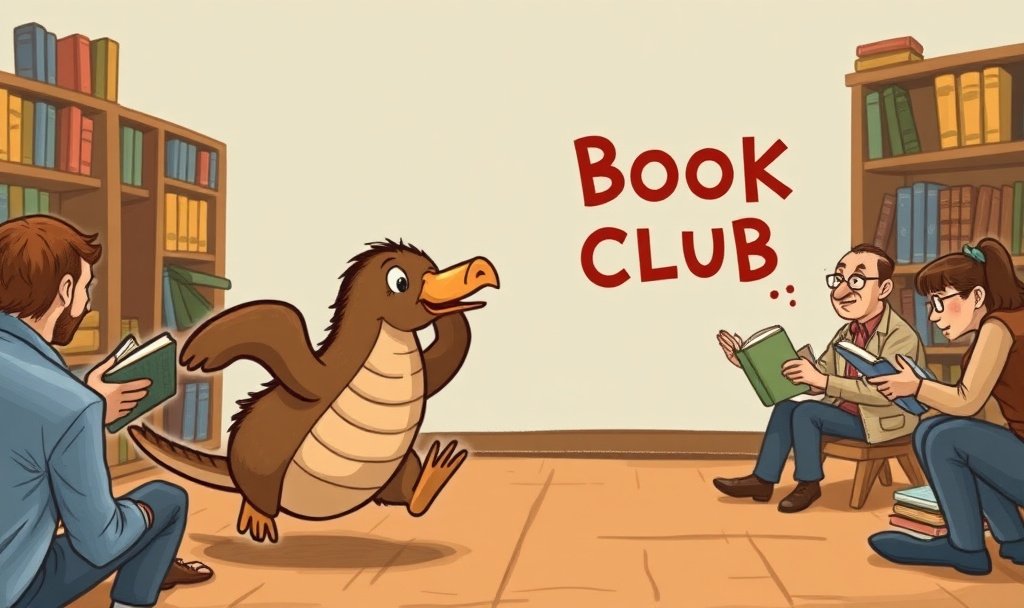
A platypus running a book club. Clipboard in flipper, asking the otters what they thought of chapter four, terrified the otters will discover it never finished the book.

A walrus knitting socks. Small glasses on the tip of its tusks, mittened flippers, dropping stitches and harrumphing.

A hedgehog conducting an orchestra. Baton in tiny paw, quills bristling on the high notes.

A teapot reading the morning paper. Folded broadsheet, reading glasses balanced on the spout, sighing about the news.

A goose teaching tai chi at dawn. Wings flowing through push the cloud, students standing very still.

A snail running a marathon. Sweatband on, bib number 47, the crowd holding the finish ribbon for three hours.
You may smile. You may think this is unserious. I would like you to notice that you smiled, and stay with what just happened in your body.
The walrus is not in the room. The walrus is vivid. You can see its socks. You can almost hear it harrumph. And yet your body knows immediately that the walrus is not real. No part of you is frightened of the walrus. The mind classifies it instantly as image, not reality, amused, moving on.
Now I would like you to do something. Pick the loudest item in your chorus tonight — the one keeping you from sending the message. Let us call it nobody will sign up. Hold it in your mind. Notice that it has color and detail and the specific bitterness of failure.
Now place beside it: a hedgehog with a baton, raised to conduct an orchestra of empty seats.
Hold both at the same time.
Notice that they are made of the same thing. Both are images. Both have detail. Both feel vivid. Neither is in the room. The hedgehog is no more or less present than the empty seats. They are siblings.
The body, presented with both at once, will eventually do something extraordinary: it will classify them the same way. The hedgehog is image. The empty seats are image. Both are vivid. Both can be set down.
This is the small operational mercy of the absurd-image practice. It does not require you to defeat your fearful thoughts. It does not require you to prove them wrong. It only requires you to show the mind that they have the same standing as the walrus knitting socks, and the mind, which is not stupid, will do the rest.
A few more pairings, for the chorus you may be hearing tonight.
Fear: She’ll see through me and realise I don’t really know what I’m doing. Twin: A platypus running a book club, terrified the otters will discover it never finished the book.
Fear: The price is too high — they’ll think I’m arrogant. Twin: A teapot standing at the door of a tea shop, charging admission to be poured.
Fear: The price is too low — they’ll think it’s not serious. Twin: A pufferfish handing out discount coupons in the lobby of an aquarium.
Fear: Nobody will sign up. The launch will land in silence. Twin: A hedgehog with a baton, raised to conduct an orchestra of empty seats.
Fear: Someone will write a cruel comment publicly. Twin: A teapot being called “too steamy” by a passing kettle.
Fear: My accent, my age, my appearance will be the reason they don’t trust me. Twin: A bumblebee asked to remove its stripes before the meeting.
I would like you to notice that these absurdities are not mocking your fears. They are companions to your fears. Each absurd image is an earnest small creature trying something incongruous — which is exactly what you are, in the moment of your own incongruous and earnest attempt.
The walrus would very much like to finish knitting the sock. The platypus does want to be a good book-club host. The hedgehog has been practicing the symphony for weeks. They are doing their best, with what they have, in shapes the world is not configured for. This is precisely your situation, made tender by the fact that the walrus is fictional and you are not.
The comedy is not against you. The comedy is for you.
There is a lineage to this practice, though I came to it the way most people do — through having to.
Marcus Aurelius, two thousand years ago: All things are dyed by the thoughts. He meant that things themselves are neutral, and the suffering is in what we add to them in the mind. He spent the last ten years of his life writing private notes to himself reminding himself of this, because even an emperor could not retain the discrimination naturally.
The Buddhist traditions have the same teaching in many forms: thoughts are clouds passing through the sky of awareness. The sky is what you are. The clouds are what crosses you. You can be confused only when you think you are a cloud.
In our own century, the women who have written most clearly about this — Byron Katie, Pema Chödrön, Tara Brach — have all said variations of the same thing: the suffering is not in the situation. The suffering is in believing the thought about the situation.
I am offering you, in this letter, a particular version of the same teaching. Compare the thought to an obviously absurd image, side by side, and let the body do the classification. That is the whole technique.
You do not need to study this for years. You do not need to meditate for forty minutes a day. You do not need to read the literature. You only need to remember: whatever just told me not to send the message is a thought. Thoughts are images. The hedgehog is also an image. They are siblings. The message can be sent.
This letter is shorter than my previous one to you. The technique is small and does not require many words.
I will close with one image, which is yours to keep.
Imagine, the next time the chorus arrives — and it will arrive tomorrow, and the day after, and the day after that — that you are sitting at your desk, about to do the thing the chorus is afraid of. Imagine you reach for the cup of matcha, or tea, or whatever is near you, and as you raise it to your lips, a small walrus in spectacles is sitting at the end of your desk, knitting socks, dropping stitches, harrumphing companionably.
It is keeping you company. It is not afraid of anything. It is doing its incongruous earnest work alongside you. The chorus, hearing the harrumph, becomes uncertain of its own footing. The fear-sentences continue to arrive, but they now arrive in the room of a walrus, and the room of a walrus is structurally a room that takes itself less seriously than the chorus would prefer.
You hit send.
The walrus continues knitting. The world continues. The thought, the message, the woman on the other end, the small bright fact of having done the thing — these enter the room, and the chorus, briefly defeated by socks, falls silent.
This is enough. This will get you through the next message, and the next one, and the next one.
Send.
With love and a wry smile,
— I.